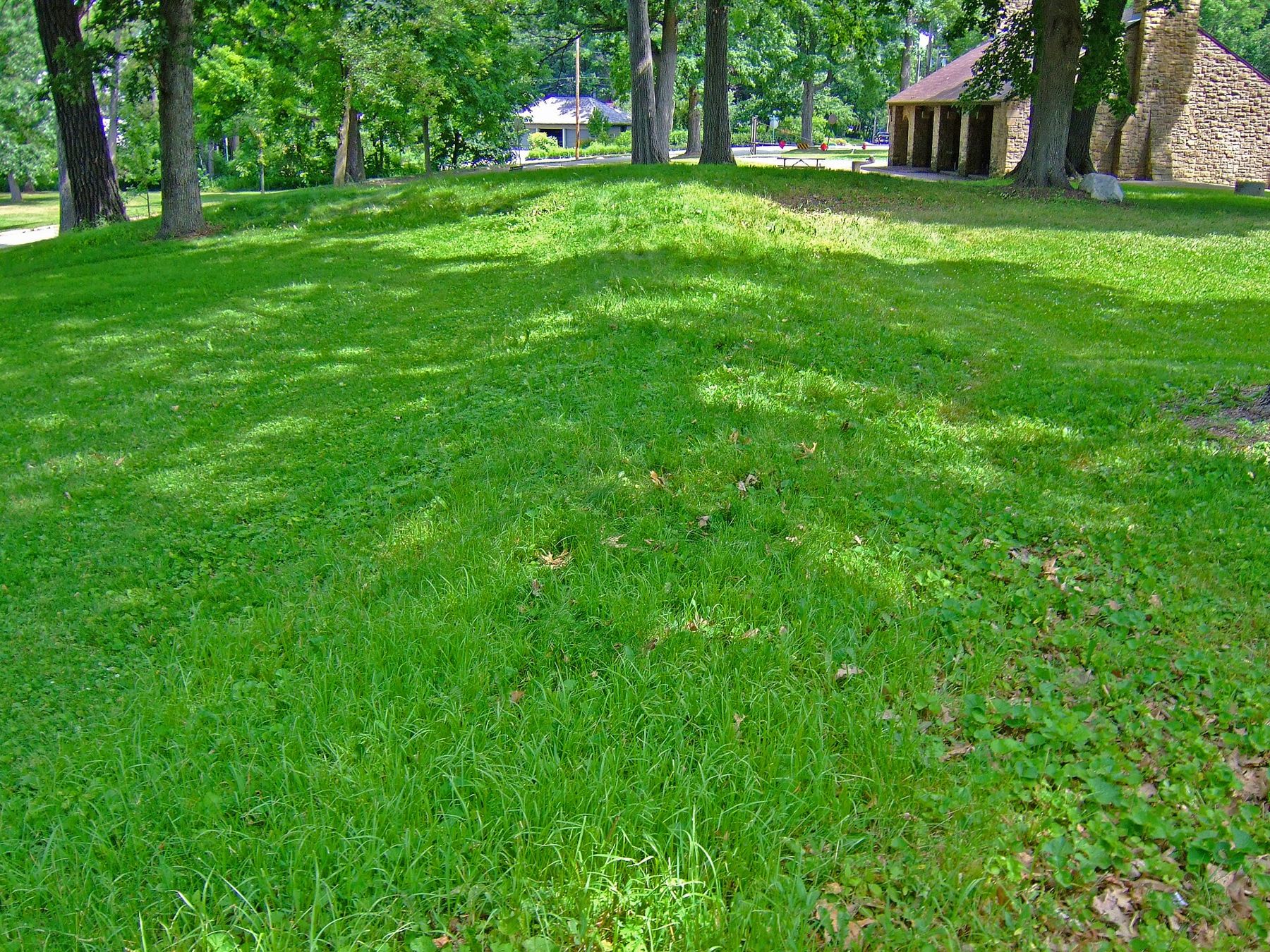
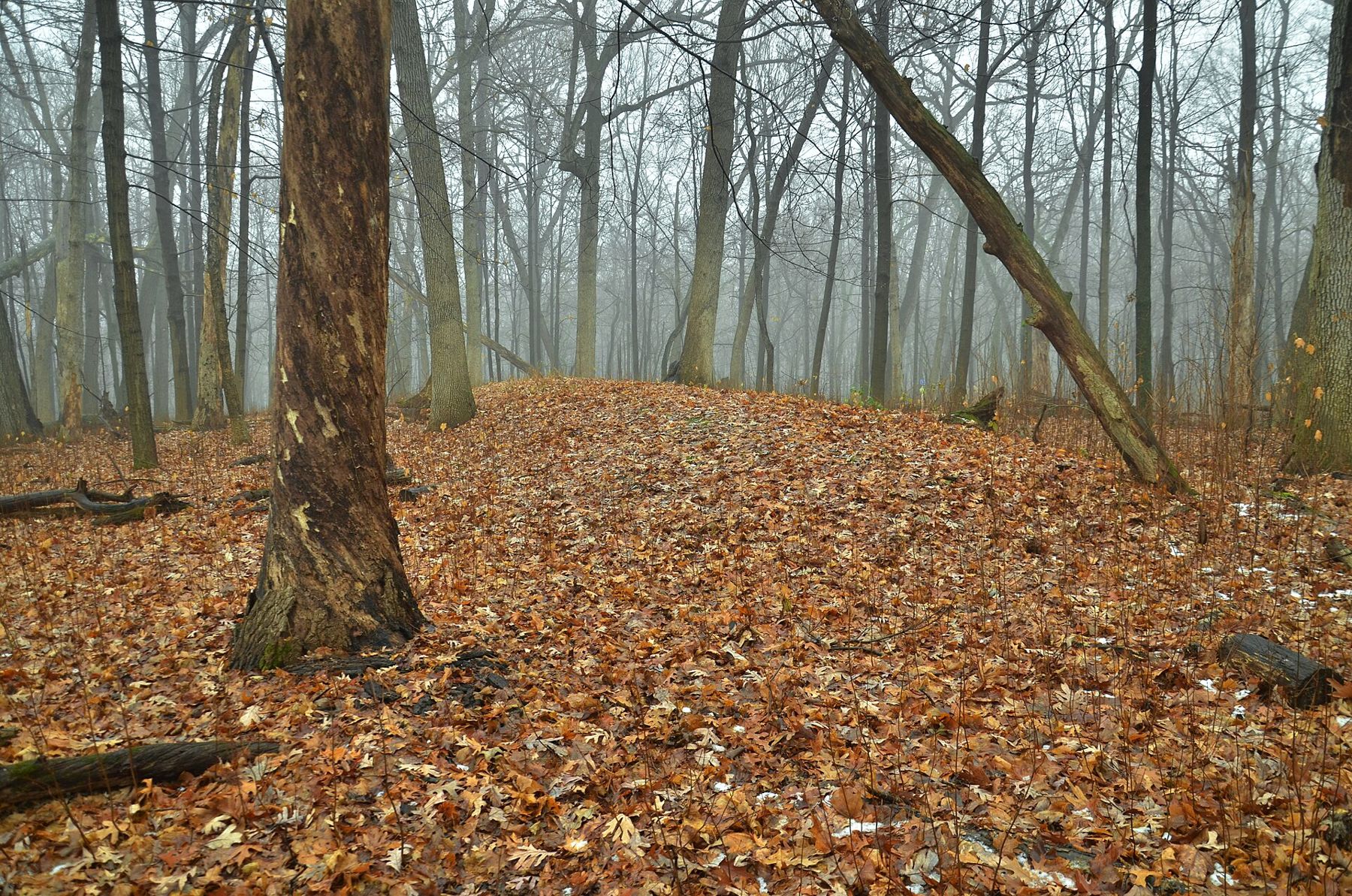
From the road, most effigy mounds look like nothing at all. A low swell in a lawn, a ridge under the leaves a few feet high, a long hump that might be a tree root or an old fence line. Then you walk along one and the shape resolves: a bird with spread wings, a long-tailed animal, a bear. The scale surprises people. Some of these figures are longer than a city block.
Who built the mounds
People have built earthen mounds in what is now Wisconsin for well over two thousand years. The earliest were mostly round, dome-shaped mounds called conical mounds, often raised over burials. Long straight mounds, called linear mounds, came later. Then, during the Late Woodland period, roughly between 700 and 1100 AD, the people living in southern Wisconsin began building mounds in the shapes of animals and spirit beings. These are the effigy mounds.
Effigy mound building was concentrated in southern Wisconsin and the neighboring edges of Iowa, Minnesota and Illinois. Wisconsin had more effigy mounds than anywhere else in the world. The builders were hunters, gatherers and small-scale farmers who moved through the year between camps near lakes, rivers and wetlands. Many mound groups stand on high ground above water, near places where people gathered in season.
Today the Ho-Chunk Nation and other tribal nations regard the mounds as sacred places and many as the graves of ancestors. They are not ruins or curiosities. They are cemeteries and ceremonial sites, and they should be treated that way.
What the shapes mean
The most common effigy shapes are birds, long-tailed animals often described as panthers or water spirits, bears, and deer or other four-legged animals. Many archaeologists and tribal scholars read them as images of the spirit world: birds belonging to the upper world of the sky, and long-tailed water spirits to the lower world beneath the earth and water. Some mound groups place the two together, which may have expressed balance between the worlds.
Not every mound held burials, and those that did often held only a few. The figures seem to have mattered as much for their shape and their place on the land as for what lay inside them. Exactly what each one meant to its builders is not known, and much of what is said about them is careful interpretation, not fact. Keep that in mind when you read signs or brochures.
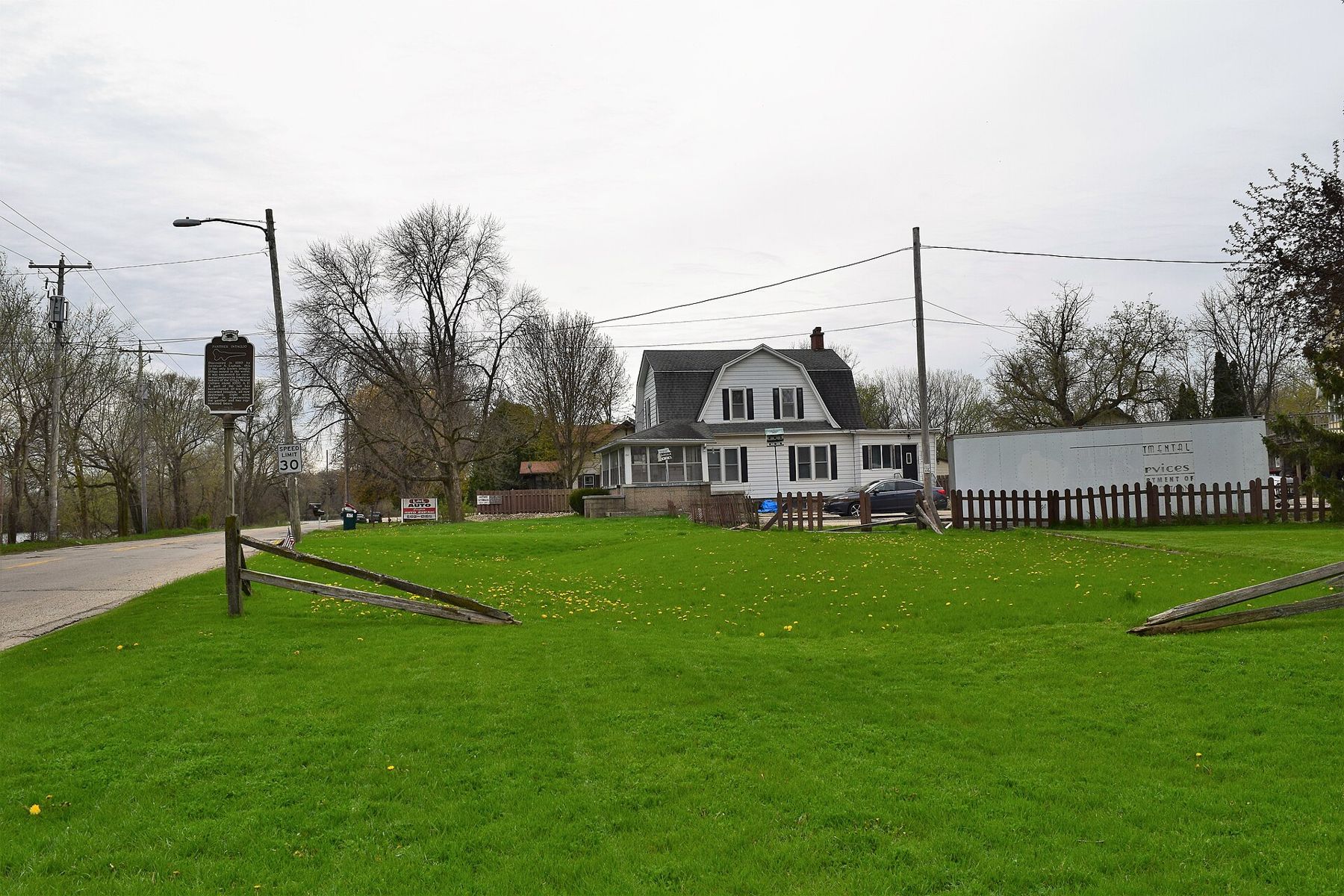
Most effigies were built up from the ground with basket-loads of soil. A very few were dug into it, as sunken shapes called intaglios. Only one intaglio effigy is known to survive in Wisconsin: the Panther Intaglio in Fort Atkinson, shown at the top of this page.
How most were lost
When settlers arrived in southern Wisconsin in the 1830s and 1840s, mounds were everywhere. Surveyors and early naturalists mapped many groups along the lakes and rivers of Waukesha, Jefferson, Dane and Walworth counties, and their maps show figures in places that are now streets, farms and subdivisions.
Most of those mounds are gone. The plow flattened thousands of them within a few decades. Others were leveled for roads, houses and quarries, or dug into by curiosity seekers looking for relics. Of the many thousands of mounds that once stood in the state, only a fraction survive, and the effigy shapes have suffered more than most, because their low, spread-out forms were easy to plow away.
What survived did so mostly by accident or by early effort: in woodlots that were never plowed, in cemeteries, on college campuses and in parks set aside by people who saw what was being lost. In the twentieth century, state law began to protect burial sites, including mounds. Disturbing a mound in Wisconsin today is illegal, whether it sits on public or private land.
Many of the surviving mounds owe their protection to people who noticed them early. Through the nineteenth and twentieth centuries, naturalists, local historians and later archaeologists recorded mound groups, pressed for their protection and, in some cases, bought the land. In recent decades, tribal nations have taken a leading role in deciding how mounds are cared for and how they are presented to visitors. Signs at many sites now reflect that.
Mounds close to the Kettle Moraine
Waukesha was once called Prairieville, and its river bluffs held one of the larger mound concentrations in the area. Almost all of them were destroyed as the city grew. A small group of round conical mounds survives in Cutler Park, near the public library downtown. They are modest, grass-covered and easy to miss; look for the marker.
Fort Atkinson has the Panther Intaglio, on protected ground beside WIS 106 on the west side of town. Walk the edge and look down into the long shallow form. Our page on Fort Atkinson has directions and the rest of the town.
Near Lake Mills, Aztalan State Park preserves something different: large flat-topped platform mounds and a reconstructed stockade from a Mississippian town that thrived around 1100 to 1250 AD. Its builders were not the effigy mound builders, though the two cultures overlapped in time. Visit both to see how varied the old landscape was.
Reading a mound on the ground
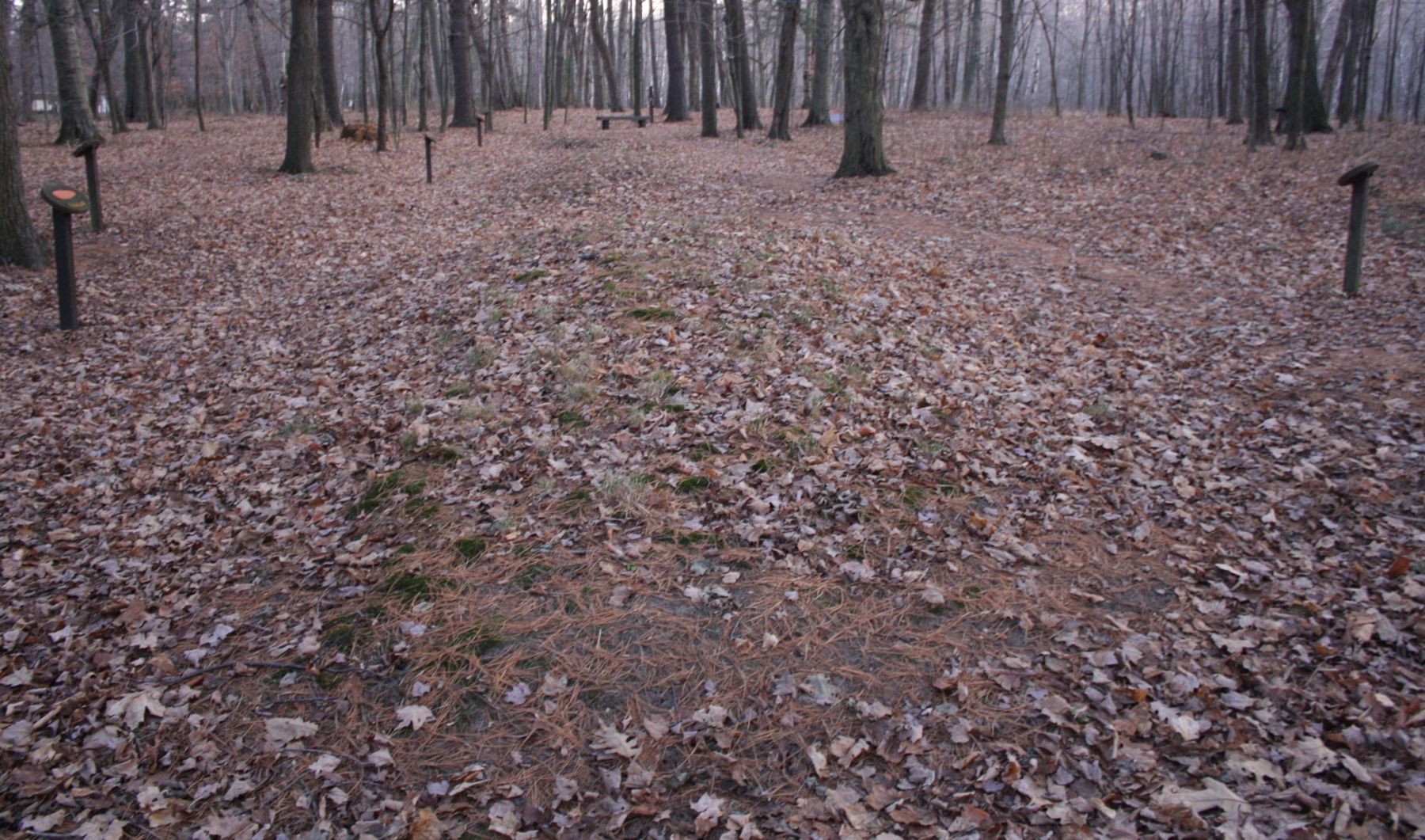
Effigy mounds are low, usually two to four feet high, and they are best read by walking their outline rather than looking at them from one spot. Start at a marker if there is one, and work out which end is the head. Birds have a body, two wings spread to the sides and often a straight or forked tail. Long-tailed animals lie on their side, with a long tail curving away behind them. Bears are compact, with short legs.
Linear mounds are long straight ridges, sometimes hundreds of feet long. Conical mounds are round domes, often in rows along a ridge. Many groups mix all three types, and the way they are placed on the ground, along a ridge, facing water or pointing the same direction, is part of what makes them a group rather than a scatter.
Signs and site plans help. Many parks post a plan of the group at the entrance; look at it before you walk, and you will recognize the shapes more quickly.
How to see what remains
Farther afield, Madison has the richest surviving mound landscape in the region, with effigies in city parks, on the university campus and in the arboretum. Sheboygan's Indian Mound Park keeps a fine group of effigy and linear mounds in a wooded park with signed paths. Lizard Mound, near West Bend, preserves a group of effigies in the woods north of Milwaukee. Each is a fair drive from the Kettle Moraine, and each is worth it.
Wherever you go, follow a few rules. Stay on the paths and off the mounds. Don't climb, sit, picnic or let children run on them. Keep dogs leashed and away. Never dig, probe or take anything, not even a stone. If you see a mound being damaged, report it to the landowner or local authorities.
Go in late October or early April, when the grass is short and the leaves are down. Walk slowly, with the low sun behind you, and let the shapes come up out of the ground. For more on the land they were built on, read our page on how glaciers made the Kettle Moraine. Then stand quietly at one end of a mound and look along its length, the way its builders meant it to be seen.